
From Customer Promise to Cash
Why Ownership of the Whole Determines Whether the Enterprise Ever Sees the Cash
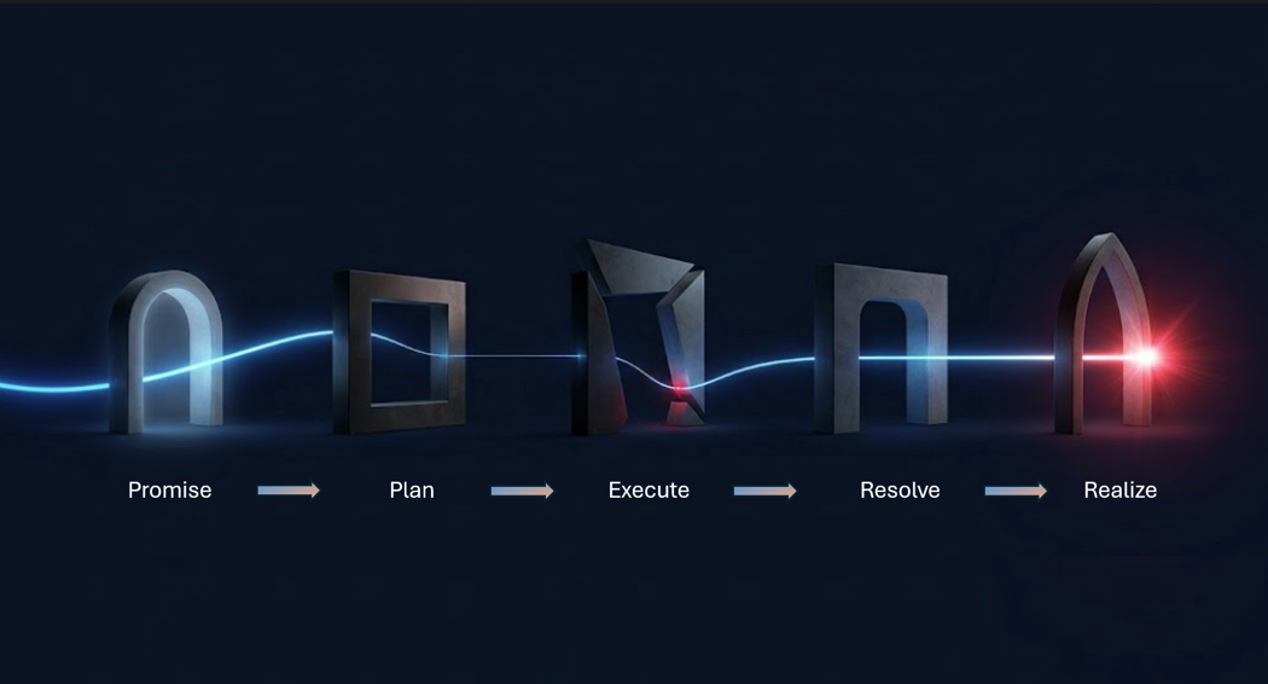
The moment of making the customer promise occurs in seconds. Converting that promise into profitable cash depends on every decision and handoff that follows — across sales, planning, procurement, manufacturing, logistics, and finance. The fix is not a new planning tool or an AI layer; it is an operating-model decision: name one owner for the whole distance from commitment to cash.
Abstract
The moment of making the customer promise occurs in seconds. The conversion of the customer promise to profitable cash depends upon all subsequent decisions and handoffs that follow — across sales, planning, procurement, manufacturing, logistics, and finance. This paper argues that the solution is not a new planning tool or AI layers, but rather an operating model-based decision: designating one responsible party for the entire distance from commitment to cash, and treating that distance as a singular, flowing process.
Executive Summary
Across the largest 1,000 U.S. nonfinancial companies traded publicly, Hackett Group reports an average cycle for converting cash of 37 days and excess working capital totaling $1.7 trillion. These numbers do not measure how long it takes to fulfill a single order. They show how decisions about inventory, receivables and payments are made once a sale conversation has concluded.
Sales makes the promise. Planning interprets demand. Procurement secures supply. Manufacturing produces. Logistics delivers. Finance bills and collects. Each function can meet its own goals but the enterprise still lets customers down by carrying too much inventory, absorbing premium costs and waiting too long to get cash. That is the central failure: excellence at functions is being mistaken for end-to-end performance.
A stronger alternative treats customer promises as a continuous economic commitment owned continuously from the start through financial realization rather than passing them department by department.
Executive Opening
McKinsey refers to lead-to-cash as an "elephant" problem due to the fact that each of the three disciplines involved see different aspects of the problem: finance sees this as a control issue; sales views this as a speed issue; and technology views this as a system issue. In other words, none of the disciplines are naturally responsible for governing the entire process.
The idea was also discussed by Harvard Business Review many years ago, using what they called "the discipline of following a single order from beginning to end". The authors stated that fragmentation cannot be seen within a departmental level because it can only be viewed when you walk the promise as if the customer did — as one ongoing commitment vs. as a series of sequential hand offs of functions.
The Problem Today
A consumer never sees an organizational chart. However, internally the "promise" created in this manner crosses multiple functional areas such as pricing, credit, order management, planning, procurement, production, inventory, logistics, billing/invoicing, claims, and collections. Each time the "promise" crosses a functional area there is potential for delays, misinterpretations, and responsibility to be quietly shifted.
This is not because each functional area is individually weak; however, companies have optimized individual functional areas but designed the enterprise as a whole. Thus, for example a planning system can help develop a better supply chain plan; however, the Sales department continues to promote orders based on assumptions that are not governed by the Planning System. Likewise a warehouse may improve its productivity; however, Transportation Constraints will likely preclude the company from meeting the promised delivery date. Finally, a Finance Department may increase their efforts in collecting monies owed to the company; however, Pricing Errors and Incomplete Documentation continue to generate disputes regarding payment obligations.
Transformation Capability and Change Readiness were the two most commonly cited planning maturity gaps from BCG's 2026 survey of 181 planning leaders. Financial Integration was also very close in ranking. This doesn't mean that fragmented processes are the sole cause of the working capital gap. What this shows us is how significant those hand-offs can become if there isn't someone governing them. As a result, we have the "un-owned" middle: the distance between commitment made and an outcome realized.
What Is Changing
Agentic AI is now also automating each step in many business functions individually (i.e., order capture, real-time production scheduling, carrier choice, constant monitoring of customer credit, and validating invoices). Only 25% of companies have started down the road toward supply chain independence as stated in Accenture's 2025 study on autonomous supply chains; median activity maturity was only 16%. More than 90% of nearly 620 executives surveyed by Bearing Point for the World Economic Forum anticipate that by 2030 AI will dramatically transform supply chains — yet only 8 percent report full integration of AI-driven planning and orchestration today.
There is a significant difference between this current state and what would be needed to create an effective supply chain through AI. The primary issue is that most organizations do not possess the appropriate operating model structure. This means that an agent who maximizes the number of orders accepted, a stocking agent who minimizes stocks held, a manufacturing agent who increases equipment utilization and a financing agent who limits the amount of money available to customers are acting logically within their respective objectives while negatively affecting the same organizational outcomes.
Core Framework: The Five Stages of the Promise-to-Cash Flow
The promise-to-cash process is an end-to-end flow; it isn't five separate functions that coordinate with each other from time to time. The ASCM SCOR Digital Standard integrates order, source, transform and fulfill under a singular orchestration layer – same hand off logic as this process, from promise to cash. Most organizations know who does the work at each level, but far fewer know who has accountability for the boundary (the point in which the promise is passed to another area within their organization).
| Stage | What Happens | Typical Owner | What Gets Lost at the Boundary |
|---|---|---|---|
| 1. Promise Formation | Price, lead time, service level, credit, and terms are set. | Sales / Customer Service | Whether the promise is profitable to keep — not just available to make. |
| 2. Planning Translation | The promise becomes a demand, supply, and inventory decision. | Planning / Procurement | Whether resourcing can fully cover what was promised. |
| 3. Execution & Fulfillment | Production, allocation, and delivery proceed against plan. | Manufacturing / Logistics | Whether execution still honors the promise as conditions change. |
| 4. Exception Ownership | Disruptions, disputes, and delays are resolved. | Whoever notices first | Whether resolution protects the customer promise — not just the shipment. |
| 5. Financial Realization | Invoicing, collection, and working-capital release. | Finance / Credit | Whether cash outcomes are ever traced back to their operational cause. |
A supply chain rarely fails at the missed shipment. It fails earlier — at the point where no one is accountable for the distance between what was promised and what the organization is actually capable of delivering.
Future State
By three years, leading organizations will create shared promise-to-cash control environments that use AI to identify risk and coordinate exceptions while there is a named owner who holds accountability for the outcome. By five years, agentic systems will make routine decisions that are executed within defined thresholds — freeing leaders to focus on strategic customers and trade-offs with real financial consequences. By ten years, the customer promise may function as a continuously managed commitment — reassessed by the organization as the conditions of supply, capacity, logistics pricing and credit change — autonomous in execution, human in accountability.
The technical barrier to achieving this type of system is already falling. The organizational barrier — determining who owns the whole — remains.
Operating Model Impact
The Enterprise Model
Each business function (planning, CRM, ERP, logistics, finance) in a modern enterprise has its own way of recording "Done." A connected system model means that these different systems must be able to share common event definitions that capture the customer's initial request ("Original Promise"), whether it was fulfilled ("Execution Status"), received by the customer ("Delivery Confirmation"), matched against what was invoiced ("Invoice Accuracy"), and finally paid ("Cash Receipt"). A single platform is not mandatory. A consistent decision architecture is.
The Business Process
The S&OP and IBP cycles are used to assess the demand, supply and margin within an organization. However, receivable collection, deductions, and the cash conversion process are not considered operating variables. This separation between processes is not based on reality — the ultimate financial outcome occurs at the time the enterprise accepts the customer's order, allocates the constraint resources available, and chooses how to fulfill the order — well before the invoice is issued.
Business Organization
Most organizations have leadership roles in planning, purchasing, production, distribution/transportation, and finance. It is rare to find an organization with a single person responsible for ensuring continuity between these departments, and who also has the authority to make decisions regarding conflicting goals among departmental personnel, and ensure that departments do not pass costs or risks down-stream.
Governance & IBP Alignment
Promise-to-cash performance should enter the IBP and execution-governance cadence rather than remain a downstream finance review. The scorecard should connect perfect-order fulfillment, promise-date adherence, margin realization, invoice accuracy, days sales outstanding, and cash-conversion cycle time into one governed system — not a longer list of disconnected metrics. Every material disagreement or each delayed payment should then trace the reason for this operational failure, and feed it into pricing, planning, services and credit policies.
Financial Alignment
Every day added to cash flow from promise to cash increases capital that the enterprise must finance itself. Causes of this — excess inventory, missed shipments, pricing mistakes, incomplete documentation, disputed deductions and delayed collections — are not isolated finance failures; they are accumulated financial results of decisions made earlier along the flow. Cash is not just the last transaction; it testifies whether the operating model worked.
Hackett Group's $1.7 trillion figure is capital enterprises already finance through debt, equity or slower growth. Closing the gap from promise to cash does not just improve a metric; it releases capital that can be used for growth resilience and strategic investment.
Strategic Actions
| Action | Why It Matters |
|---|---|
| Name an accountable owner for the full flow | Authority across commercial, operational, and financial boundaries — not just reporting. A process owner without decision authority becomes another coordinator. |
| Replace functional metrics with one shared scorecard | Connect fulfillment, promise-date adherence, margin realization, invoice accuracy, and cash-conversion cycle time into a single governed performance system. |
| Extend AI governance to the handoffs, not only the tasks | Route material exceptions to a named owner, with customer and financial exposure visible before the decision is made — not after. |
| Report cash-conversion performance at board level | Alongside service and margin, not as a finance-only disclosure reviewed after operating decisions have already been made. |
Risks of Inaction
Fragmented organizations will continue to absorb excess inventory, premium freight, missed commitments, margin leakage, invoice disputes, and delayed cash. These are all examples of how AI will only expand this gap. Organizations which have clear ownership and policy guidelines will use agents to shorten their decision-making cycle times, while fragmented organizations may simply automate incompatible decisions faster.
Closing Insight
The supply chain doesn't fail when you miss a delivery. It fails before that. It fails as soon as there isn't an individual who takes responsibility for the difference between what was said would happen and what your organization really has the capability to provide. The reason cash is so visible is because it represents where the failure occurs.
The organizations that pull ahead will not be the ones with the most advanced planning systems or the most AI-enabled workflows in isolation. They will be the ones that name a single owner for the whole distance between a customer's yes and the cash in the bank.
Series Connection: Trinity Insights
| # | Trinity Insight | Topic / Framework |
|---|---|---|
| 001 | The Trinity Pyramid™ | Introduction to the five-layer Trinity Pyramid — from Digital Trust to Strategic Optimization. Read → |
| 002 | From Planning to Orchestration | The ADAPTIVE™ Model — eight interconnected layers for a new planning operating model. Read → |
| 003 | Digital Trust Foundation | The TRUST™ Framework — governed data, secure integration, and AI-readiness at Layer 1. Read → |
| 004 | Workflow Automation Imperative | DARE™ Framework — AI-enabled supply chain transformation. Read → |
| 005 | Human-Led AI Planning | The GUIDE™ Framework — Trinity's operating model for Human-Led AI Planning. Read → |
| 006 | Enterprise Decision Orchestration | The ORCHEST™ Framework — cross-functional decision alignment and the Decision Cockpit. Read → |
| 007 | Strategic Optimization Architecture | The APEX™ Framework — enterprise outcome optimization above orchestration. Read → |
| 008 | The Next Kodak Is Not A Technology Company | Why Governance — Not AI Adoption — Will Decide the Next Generation of Enterprise Winners. Read → |
| 009 | Leadership Lessons for the AI Era | What Satya Nadella Teaches Supply Chain and Enterprise Leaders About Governing AI Without Ego. Read → |
| 010 | From Systems of Decision to Systems of Action | The Ownership Test™ — who owns an autonomous action when no human chose it. Read → |
| 011 | From Customer Promise to Cash | The Five Stages of the Promise-to-Cash Flow — who owns the distance from commitment to cash. Current paper. |
Work With Trinity Solutions LLC
Trinity Solutions LLC helps enterprises move from systems of decision to systems of action — inventorying where AI already executes, running the Ownership Test™ across every action class, and standing up the Action Ownership Register as a board-level discipline. Every engagement begins with human judgment and ends with enterprise resilience.
trinitysolutionsglobal.com | Human-Led. AI-Assisted. Wisdom-Driven.
References
- The Hackett Group — 2025 U.S. Working Capital Survey: Payables Rebound, but Receivables and Inventory Lag. 2025. thehackettgroup.com
- McKinsey & Company — Lead-to-Cash: The Elephant in the Room. 2024. mckinsey.com
- McKinsey & Company — Finding Hidden Value with Order-to-Cash Optimization. 2022. mckinsey.com
- Accenture — Making Autonomous Supply Chains Real. 2025. accenture.com
- BCG (Garro, Caffrey, Shetty, Dunn, Sieke, Cheraghi) — Supply Chain Planning 2026: Why AI Alone Isn't Enough. 2026. bcg.com
- ASCM — SCOR Digital Standard: Introduction to Processes. 2026. ascm.org
- World Economic Forum, citing BearingPoint — Autonomous Intelligent Supply Chains: How AI and Regionalized Supply Chains Are Shaping the Next Phase of Globalization. 2026. weforum.org
- Harvard Business Review (Shapiro, Rangan, Sviokla) — Staple Yourself to an Order. 1992. hbr.org