
From Systems of Decision to Systems of Action
Why the Next Leadership Challenge Isn't AI — It's Ownership

When AI acts instead of advises, the human approval check point is removed for good. The companies that get their autonomous systems scaled up first will be the companies that have established ownership over their actions long before giving them authority.
Abstract
Supply Chain Technology has been helping leaders make decisions for nearly ten years. Today it's beginning to act. Agents are making orders, allocating, and rerouting goods, then reporting back to humans later, or possibly never. The capability question (can the system act?) has been solved. The ownership question (who owns the action when no human chose it?) has not. The limiting factor for an autonomous supply chain is no longer AI maturity. It is ownership maturity.
Supply chains have worked over a decade optimizing their decisions — and these decisions are now good. However, results continue to be inconsistent: inventory imbalances persist and the same exceptions appear again every time. The decision quality in supply chains is much better than it was before; however, the consistency of how well those decisions are executed has not improved. Intelligence as a barrier to success is gone. Ownership is the new barrier.
The main conflict that exists today is no longer Human vs. Artificial Intelligence. Today's conflict is Automation vs. Accountability — and the accountability will always remain a function for humans. Technology can recommend; agents can execute; ownership cannot be delegated.
The next transformation challenge is not AI maturity — it is ownership maturity. What no one can see, shape, answer for, and stop, no one owns; and what no one owns, no one should have deployed.
The Shift: From Decision to Action
Enterprise technology has developed through three generations. Systems of Record (ERP) standardised transactions; Systems of Decision (Planning, Control Towers, AI Analytics) improved decisions. Both assumed there was a human standing between insight and consequences. The third generation — Systems of Action — eliminates that human by design. Agentic systems no longer advise; they take an action. Systems of Decision answer "What shall we do?" Systems of Action answer a harder question: "Who owns doing it?"
The industry made this transition quietly. No CEO could sign off on 10,000 replenishment orders a day. Add an approval process for them and you lose the rapidity you paid for. The typical solution is a false sense of security — "Human-In-The-Loop" is merely theatre. Someone rubber stamps a quantity of requests he cannot review. There is no real decision with unclear accountability — only a suggestion.
Three shifts shorten the time frame. AI eliminated the time gap for making a decision, therefore the time constraints move from what to make a decision on to how quickly it can be executed; Planning is moving towards being continuous, requiring accountability instead of periodic meetings; and Agentic systems are executing (triggering replenishment, reallocating supply, rerouting logistics) yet many organizations cannot determine who is accountable when systems operate independently. Execution, not Intelligence, will determine competitive advantage in the next 2–5 years.
The Core Framework: The Ownership Test™
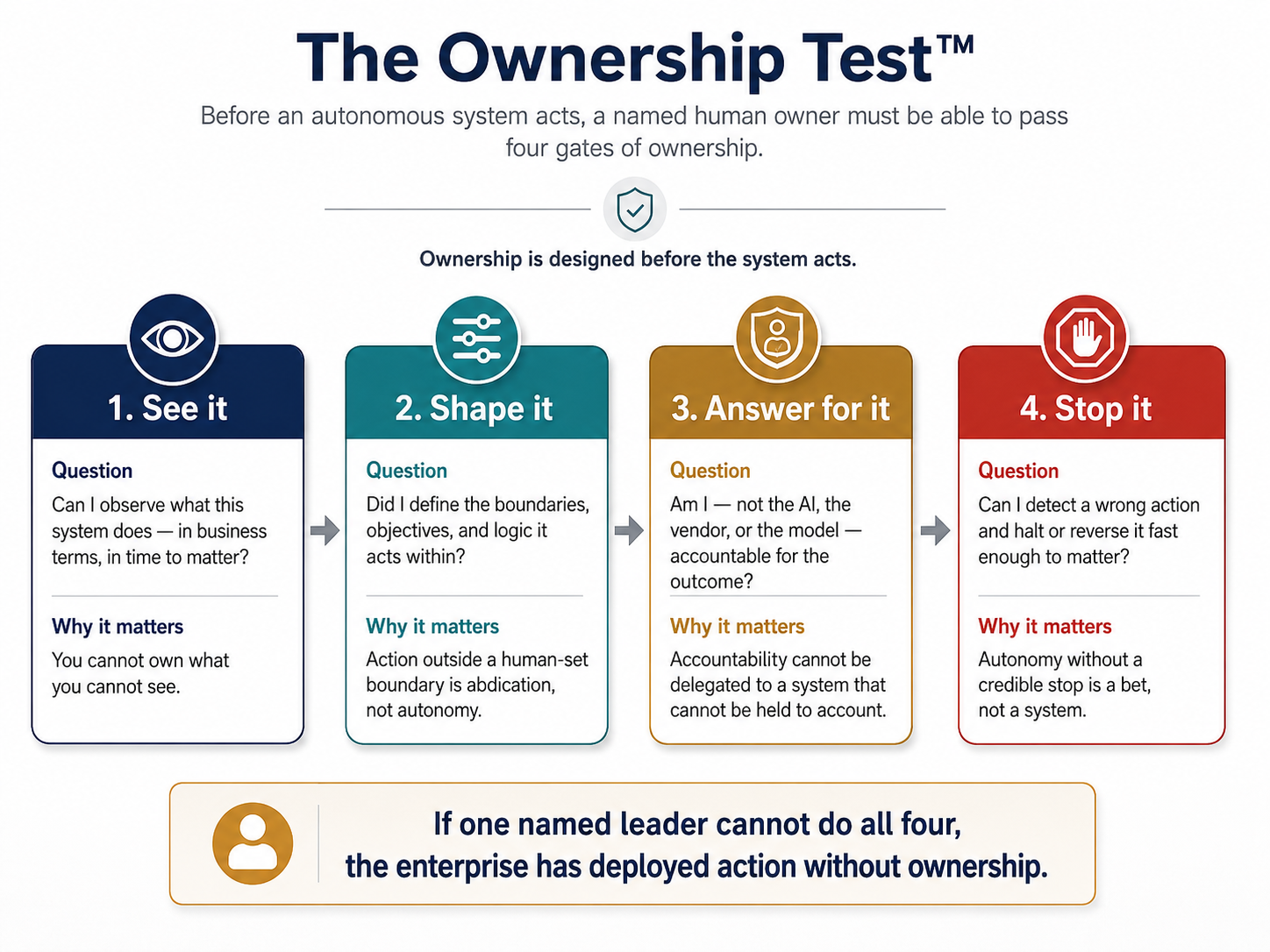
Ownership of an autonomous action is not a name that we assign to our failure in using it as a control tower — it is a design process before the system takes action. When the check point disappears, ownership is the capability to see, shape, answer for, and stop a class of actions. If a named leader can't perform the four tasks, then the enterprise has deployed action without ownership.
1. See it
The leader will have a "live" view of how the system is performing at the exact moment of operation — not through a weekly review of a system dashboard.
2. Shape it
The leader has already determined the boundaries of performance of the system — not after go-live, but before authority is granted.
3. Answer for it
The leader can stand in front of the board, the CFO, or the customer and clearly explain all significant outcomes resulting from the operation of the system — no holes, no disclaimers.
4. Stop it
The leader has a single-step kill switch that they control personally — not a help desk ticket, nor a phone call to the vendor.
These four gates occur sequentially and not as options. An owner who sees and shapes but does not answer for or stop has partial transparency and zero accountability. This is not ownership; this is exposure. The Ownership Test™ is only completed when all four gates are passed and should be repeated anytime the action class increases in either scope, quantity or severity.
Future Operating Model
In the Systems-of-Action model, decision-making and execution are now a single process. Each action includes a named owner; a specified pathway through ERP/WMS/TMS; and a quantifiable financial result. Visibility towers cease to be visibility tools and become ownership tools — showing what was done; in whose authority; what financial results occurred from doing so; and providing a believable one-step termination. The protection chain extends from strategy to mandate to autonomous action to financial outcome, with a named owner across all four.
| Dimension | Shift Required |
|---|---|
| Systems | Planning platforms evolve from generating recommendations to enabling governed execution. |
| Process | Periodic planning gives way to continuous orchestration and predefined response pathways. |
| Organization | Leadership expands from managing functions to governing humans, AI agents, and autonomous workflows. |
| Governance | Accountability shifts from approval-based control to ownership-based oversight. |
| Yesterday | Tomorrow |
|---|---|
| Functional silos | Enterprise orchestration |
| Decision support | Action orchestration |
| Information visibility | Accountability visibility |
| Escalation culture | Distributed decision rights |
| Systems of record | Systems of action |
Through The Ownership Test™, the Action Ownership Register is implemented at a board level. No systems can operate without first having a named owner pass all four gates. A named owner will document and review their boundaries and stops with the same frequency that they are reviewed by the Board of Directors in relation to the Enterprise Risk Register; this will be included as part of the Board's metrics, not as an IT project line item. This builds upon GUIDE (Trinity Series-005) which governs who approves a recommendation, and ORCHEST (Trinity Series-006) which governs decision-making rights, and it represents the next step beyond SCM's SCOR DS and IBP Governance as execution becomes automated. When each action is tied to a named owner, the large gap between planned and achieved value is closed — better working capital utilization, improved reliability of services provided and quicker achievement of revenue goals.
Strategic Actions
| Imperative | The Move |
|---|---|
| Inventory systems of action | Map where AI already executes, not merely recommends. It is further along than it feels. |
| Run the Ownership Test™ | Apply the four gates to every action class. Where any gate fails, build the capability or revoke the autonomy. |
| Stand up the Register | Grant no system authority to act until a named owner passes all four gates. Elevate agentic-governance maturity to a board metric. |
Closing Insight
The "laggard" fails in a way different than an "AI's failure to perform"; it fails because an "AI performs with no accountability as it makes mistakes at scale". The "invisible cost" is a single incorrect action made thousands of times until someone recognizes the issue, with no ownership in place to prevent it from happening. The debate for a decade has been "can the machine decide?" — today the debate is about whether the organization will claim ownership for what it decides.
Trinity Insights Series — Framework Lineage
| Series | Framework | Purpose |
|---|---|---|
| 005 | GUIDE™ | Governs who approves each AI recommendation. |
| 006 | ORCHEST™ | Governs cross-functional decision rights and override paths. |
| 010 | Ownership Test™ | Governs who owns an autonomous action. (Current paper.) |
Series Connection: Trinity Insights
| # | Trinity Insight | Topic / Framework |
|---|---|---|
| 001 | The Trinity Pyramid™ | Introduction to the five-layer Trinity Pyramid — from Digital Trust to Strategic Optimization. Read → |
| 002 | From Planning to Orchestration | The ADAPTIVE™ Model — eight interconnected layers for a new planning operating model. Read → |
| 003 | Digital Trust Foundation | The TRUST™ Framework — governed data, secure integration, and AI-readiness at Layer 1. Read → |
| 004 | Workflow Automation Imperative | DARE™ Framework — AI-enabled supply chain transformation. Read → |
| 005 | Human-Led AI Planning | The GUIDE™ Framework — Trinity's operating model for Human-Led AI Planning. Read → |
| 006 | Enterprise Decision Orchestration | The ORCHEST™ Framework — cross-functional decision alignment and the Decision Cockpit. Read → |
| 007 | Strategic Optimization Architecture | The APEX™ Framework — enterprise outcome optimization above orchestration. Read → |
| 008 | The Next Kodak Is Not A Technology Company | Why Governance — Not AI Adoption — Will Decide the Next Generation of Enterprise Winners. Read → |
| 009 | Leadership Lessons for the AI Era | What Satya Nadella Teaches Supply Chain and Enterprise Leaders About Governing AI Without Ego. Read → |
| 010 | From Systems of Decision to Systems of Action | The Ownership Test™ — who owns an autonomous action when no human chose it. Current paper. |
| 011 | From Customer Promise to Cash | The Five Stages of the Promise-to-Cash Flow — who owns the distance from commitment to cash. Read → |
Work With Trinity Solutions LLC
Trinity Solutions LLC helps enterprises move from systems of decision to systems of action — inventorying where AI already executes, running the Ownership Test™ across every action class, and standing up the Action Ownership Register as a board-level discipline. Every engagement begins with human judgment and ends with enterprise resilience.
trinitysolutionsglobal.com | Human-Led. AI-Assisted. Wisdom-Driven.
References
- Gartner — Top Strategic Technology Trends 2025: ~15% of day-to-day work decisions autonomous by 2028; ~33% of enterprise software agentic by 2028. gartner.com
- Gartner — Predicts Over 40% of Agentic AI Projects Will Be Canceled by End of 2027. 2025. gartner.com
- McKinsey & Company — The State of AI in 2026: Shifting to the Agentic Era. 2026. mckinsey.com
- McKinsey & Company — Seizing the Agentic AI Advantage. 2025. mckinsey.com
- ASCM — SCOR Digital Standard (SCOR DS) and Integrated Business Planning Reference Frameworks. 2025. ascm.org