
Leadership Lessons for the AI Era
What Satya Nadella Teaches Supply Chain and Enterprise Leaders About Governing AI Without Ego
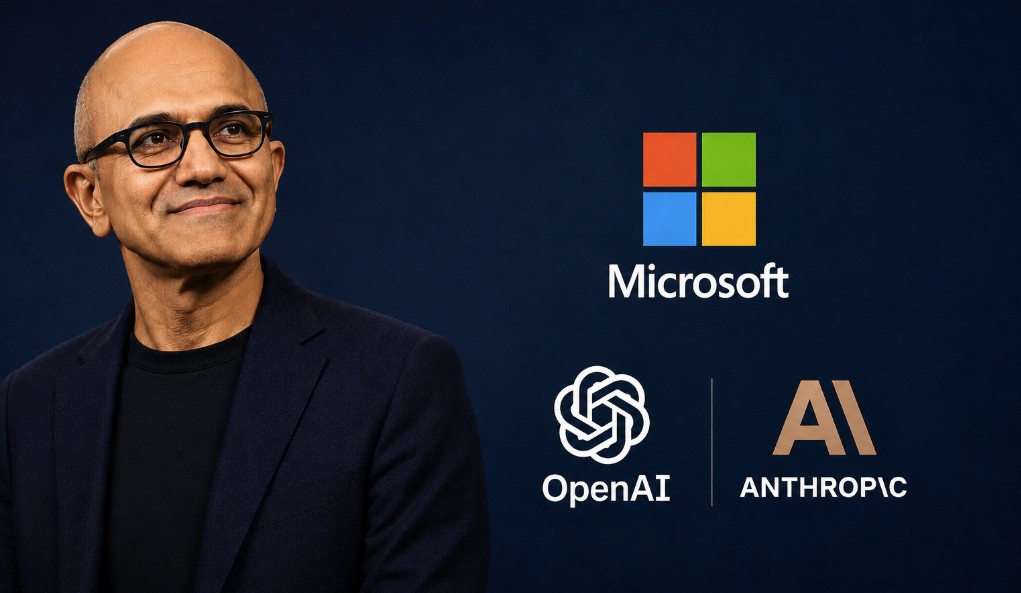
In late November 2025, Microsoft made a major announcement about an AI partnership it had entered into with Anthropic: A $5 billion investment in Anthropic and commitments by Anthropic to utilize over $30 billion worth of azure compute capacity. Six months later, Microsoft transitioned thousands of its own software engineering staff from using Anthropic's AI coding tool Claude Code toward utilizing GitHub Copilot CLI.
Many interpreted this as a contradiction. This was not. It was a demonstration of governed leadership.
In essence, the argument of this paper is that Nadella provided the enterprise leaders with exactly the leadership competency they will need to lead their organizations through the AI Era: The ability to commit to bold strategic decisions and execute structured learning experiments; the ability to fairly assess evidence; and the ability to disengage or modify a deployment decision based on evidence rather than pride - all the while maintaining an unbroken relationship with a partner who has remained committed to the original agreement.
The Leadership Question Worth Asking
A $35 billion dollar business relationship between two of the most influential organizations in AI (and the company's deliberate choice to transition thousands of their engineers out of one tool, six months after they had decided) will likely influence your next Supply Chain or Enterprise AI decision.
This isn't about money. This is about the style of leadership it exemplifies. Great leaders still possess the same characteristics as before. These include clarity, courage, judgment, accountability. The difference today is how quickly these traits are being evaluated. Organizations used to require months to procure an AI tool; now we deploy them to thousands of users in days. Additionally, token-based usage charges can grow exponentially faster than the way annual budgeting was structured. The competitive pressure to adopt is real. So is the governance imperative to govern what you adopt — and to correct a deployment decision, cleanly, when the evidence calls for it.
In this environment, the most important quality that defines a successful leader is not making the right decision when the organization commits to it, but evaluating that decision over time as truthfully as possible and acting without ego to reverse a decision when the evidence dictates doing so. I believe few people demonstrate this quality. No executive within enterprise technology has demonstrated this quality as frequently or as obviously as Satya Nadella.
What Actually Happened — And Why It Matters
In November 2025, Microsoft made one of its largest AI investments: $5 billion in Anthropic, alongside Anthropic's commitment to purchase $30 billion of Azure compute capacity. Anthropic's claude models are now being used with azure ai and also within Microsoft 365 Copilot and GitHub Copilot. This strategic partnership continues without interruption.
Anthropic's models will continue to be available for users of copilot CLI along with OpenAI and Microsoft's own models.
The change was limited and very narrow: what Microsoft decided on how their internal engineering teams would utilize a single Anthropic product. This is where your leadership lesson begins.
| Date | Event |
|---|---|
| June 2025 | Microsoft launches "Claude Code" to developers through the use of GitHub Copilot (the first time an Anthropic model is made available within a Microsoft Developer Tool) |
| November 18, 2025 | Microsoft, Nvidia and Anthropic announce a multi-party collaboration agreement. Microsoft agrees to invest as much as $5B in Anthropic. Anthropic will buy as many as $30B worth of Azure Compute. All three parties agree on the inclusion of Anthropic's Claude Models inside Microsoft's Azure AI, Microsoft 365 Copilot and GitHub Copilot. |
| December 2025 | Microsoft begins deploying "Claude Code" to nearly 5000 employees working for the company's Experiences and Devices Division. These employees develop products such as Windows, Microsoft 365, Outlook, Teams and Surface. Both technical and non-technical staff members were allowed to participate in this effort. Microsoft's goal is to have these employees become proficient in using "Claude Code" and test it in their actual work-flow environments. |
| January–April 2026 | The results are impressive. The usage rate for "Claude Code" reaches 84% to 95% of the engineering cohort. Employees running both the "Claude Code" and the GitHub Copilot CLI simultaneously provide Microsoft with feedback based upon a formalized internal evaluation process. |
| May 14, 2026 | Rajesh Jha EVP Issues A Memo To Internal Staff: "Claude Code was an important part of our learning…at the same time Copilot CLI has provided us with what I believe is something especially valuable: a product which we may influence directly thru GitHub". Most licenses for "Claude Code" are canceled. Employees begin transitioning from "Claude Code" to the GitHub Copilot CLI. |
| June 30, 2026 | A Transition Deadline is established. This date coincides with Microsoft's Fiscal Year End. In addition to the individual model options, all three types of models ("Claude", "OpenAi" and "Microsoft") are still accessible through the "GitHub Copilot CLI". The broader collaborative relationship between Microsoft and Anthropic remains intact as does the Foundry Agreement. |
Microsoft deliberately and intentionally put this code out there, they didn't decide on this for no reason. They also chose to exit it and make that intentional choice (as opposed to being reactive). They conducted a controlled experiment with their engineering workforce. They were able to deploy the solution at scale, run parallel benchmarks of the two solutions using GitHub Copilot CLI, collect user feedback comparing the solutions and made an informed decision about how to govern their transition. As EVP Rajesh Jha wrote in his internal memo: "When we began offering both Copilot CLI and Claude Code, our goal was to learn quickly, benchmark the tools in real engineering workflows, and understand what best supported our teams.
That is not a retreat. That is a learning organisation operating as Nadella designed it to operate.
The strategic partnership with Anthropic is growing. What Nadella corrected was not the commitment — it was a specific deployment decision, with evidence in hand and ego set aside. That distinction is the entire lesson.
The Leadership Portrait: Four Decisions, One Philosophy
To understand how important the Claude Code transition is, you need to know about Satya Nadella as a leader. This isn't just a list of decisions he has made; it is one consistent leadership approach applied over 10 years and through vastly changing conditions.
1. The Cultural Foundation (2014)
The cultural foundation of Nadella's first action as CEO wasn't about strategy; it was about changing the culture of Microsoft. Nadella wanted to move Microsoft from being "the know-it-all" company to being "the learn-it-all" company. As described in Hit Refresh by Nadella, Nadella removed the rank-and-file structure that encouraged employees to compete with one another rather than work together to achieve common goals. Nadella realized a fundamental truth: if you punish your employees when they tell the truth, they will fight to keep their bad decision-making alive. Therefore, Nadella changed the culture at Microsoft before he developed strategies, because ultimately the culture is how you govern everything that comes after. The Claude Code Experiment which included deployment with boldness, measuring against rigorous benchmarks and correcting without ego is the same culture, but much clearer to see twelve years after Nadella initially attempted to create this new way of working.
2. The Cloud Commitment (2014–2018)
When Enterprise Cloud Adoption was still a speculative area for most Boards, Nadella transitioned Microsoft into "Mobile First, Cloud First" positioning. As an initial Hypothesis, he committed completely, while monitoring all of the outcomes with honesty. In less than a decade, Microsoft's Market Capitalization went from approximately $300 Billion to greater than $2.5 Trillion. The lesson is the discipline: commit with conviction, monitor without ego, let the evidence govern the evaluation.
3. Decision Under Pressure: The OpenAI Moment (2023)
Nadella's public offer to hire Altman and his team only hours after being informed of Altman's removal by OpenAI's board allowed Nadella to stabilize Microsoft's position prior to opening for trading on the day. The speed of this reaction was praised by Fortune magazine as "a master class in rapid decision making". In addition, the speed of this reaction led to an approximate increase in Microsoft's market capitalization of $63 Billion during a single trading session. That speed wasn't due to instincts; rather, Nadella has mapped out the various possible future events prior to their occurrence. Therefore, preparation is the key to allowing for such speedy responses.
4. The Anthropic Experiment and the Governed Correction (2025–2026)
Nadella spent $5B on Anthropic and also rolled out the top Anthropic developer tool to 5000 of Microsoft's engineers. That is intellectual courage and strategic curiosity operating at an Enterprise scale. Nadella wasn't hedging. He was learning. Once Nadella had the results from the benchmarking — 84-95% utilization rates; token costs which required some form of fiscally governed budget control; a strategic rationale for consolidating toolchains using GitHub Copilot — Nadella took action. Quickly. Quietly. Without defending his original deployment decision.
Four decisions and in completely different contexts. Consistently Nadella demonstrated his commitment to his leadership values: commit with confidence; monitor with detachment; make corrections when supported by data and without being ego driven.
The measure of a leader is not how many right decisions they make. It is how quickly and honestly they act when the evidence calls for a correction — and how cleanly they make it, without ego, without drama, without delay.
Three Governance Lessons Every Enterprise Must Internalise
The example of Microsoft's Claude Code illustrates an issue facing all companies that are deploying AI toolsets, across sectors, sizes and levels of complexity; to which they can relate today. According to Clayton Christensen in "The Innovators Dilemma", companies make good decisions based on the logic of their current commitments and costs. Enterprise financial governance models were developed to support seat-based SaaS licensing - where usage and spend are well understood, finite, and stable. Tokenized AI consumption does not operate as SaaS usage and spend does. Rather tokenized AI consumption operates similarly to cloud infrastructure. The enterprise must develop a financial governance model that aligns with its consumption model - this cannot occur after deployment has begun and the organization has adopted use at scale.
| GUIDE™ Pillar | Design Principle | The Enterprise Governance Imperative |
|---|---|---|
| G — Governed Decision Authority | Assign explicit human ownership for every AI tool category, cost threshold, and intervention authority before deployment begins. | A 5,000-engineer deployment without pre-defined cost ownership or consumption thresholds will produce a reactive governance decision. Define authority before the first licence is issued. |
| U — Unified Planning Intelligence | Integrate AI tool consumption into a single financial visibility layer aligned to budget models and operating cadence. | Token-based billing that compounds across thousands of daily users must be visible in near real time against budget assumptions — not discovered after a threshold has already been exceeded. |
| I — Insight-to-Action Workflow | Design the escalation workflow that converts consumption signals into a governed decision before deployment reaches scale. | Visibility of usage data is not sufficient. The structured process that converts that data into a leadership decision must be designed before the tool is deployed — not after. |
| D — Decision Role Architecture | Define AI Governance Lead, Decision Orchestrator, and Scenario Analyst roles before any enterprise-scale AI tool rollout. | When engineers reach 84–95 percent adoption of a tool, the governance decision about that tool's future has already been made by behaviour. Role architecture must precede deployment, not follow it. |
| E — Executable Governance Standards | Embed AI tool governance into operating cadence: budget cycles, S&OP, IBP, and executive review processes. | A structured benchmarking exercise — running two tools in parallel and collecting comparison feedback — is exactly what executable governance looks like in practice. Design it before you deploy, not during. |
Trinity's GUIDE™ Framework — presented in Series #005: Human-Led AI Planning — define the five governance pillars necessary for large-scale Enterprise AI deployments to occur. The Table Above establishes each of Guide's Five Pillars as a mapping to one of the five enterprise governance imperatives. When combined together, these five pillars provide the governance architecture that distinguishes between a structured learning experience which ultimately leads to a governed decision (as was done by Microsoft) and unstructured and uninformed adoption that will end in a reactive cost crisis.
As Peter Drucker observed: "There is nothing so useless as doing efficiently that which should not be done at all." The governance imperative is not to slow AI adoption. It is to ensure that every deployment decision is made within an architecture that knows what it is doing, at what cost, under whose authority, and with what structured learning process in place to evaluate the evidence before the next decision is required.
The Supply Chain Parallel: Why This Matters for Your Enterprise
AI decisions made by supply chain executives today will set the stage for their companies' competitive positioning over the next five years. Companies are moving quickly to select AI planning platforms. While automation investments continue to grow, many organizations do not yet have adequate governance framework in place. Workflow management systems are increasingly being integrated into IBP and S&OP processes built with human decision-making as a primary focus. Pricing models based on token or usage in supply chain software licensing are emerging as alternatives to traditional license models which were well understood by finance departments.
BCG's 2026 Supply Chain Planning study states directly that just one in five of its supply chain planning leaders say their advanced AI capabilities have provided real benefits to their supply chain planning. Data quality and data governance are the number one barriers to realizing these benefits. This is supported by McKinsey's 2026 AI Trust Maturity Study which says that about one-third of all companies report that they have enough level of governance maturity in place to support the active use of AI as part of their enterprise.
The question is not whether to adopt AI tools. Every supply chain organization must. The question is how that implementation will be guided by the same principles as Nadella demonstrated – A defined Learning Objective, Honest Benchmarking, and the organizational culture to effectively implement a Governed Correction (cleanly, quickly, and with no Ego) based on the Evidence at hand.
Gary Hamel stated that "The greatest danger in times of turbulence is not the turbulence itself, but to act with yesterday's logic." Acting on traditional governance models for SaaS-era governance models to support the use of tokens in consuming AI would be acting like things are still at yesterday's level. The same can be said when continuing to fund a planning application (as an example), investing in an automation tool, making a commitment to a supplier based on the fact that you have already made significant investments in this area — instead of ensuring that your commitment continues to generate value.
Trinity's ORCHEST™ Framework (Series #006) provides transparency and auditability as a core pillar for enterprise decision orchestration: The version history of all decisions; Assumption logs; Decision Trails: Every Commitment is linked both backward to Strategic Intent and forward to Execution Impact. This principle also has relevance to AI Tool Governance. An organisation which can't audit the decision trail of an AI deployment can't control how it will evolve.
Resilience helps organisations recover from disruption. Optionality — the disciplined preservation of the ability to correct course — helps them govern their commitments actively over time. The supply chain leaders who will define the next decade are building both.
Five Questions Every Board Must Be Able to Answer
Only 28% of companies have CEOs directly responsible for AI governance according to McKinsey's 2026 AI Trust Maturity Survey. Only 17% reported having their boards oversee AI governance. With the evidence indicating that by end of 2026, over 40% of enterprise software will include AI agents – up from fewer than five percent in 2025 -- this is now an unsustainable corporate governance posture.
| Governance Question | What Your Board Must Be Able to Answer |
|---|---|
| Cost Visibility | Do you have real-time visibility of AI consumption costs by tool, team, and use case — or are you governing AI spend with financial models designed for flat, seat-based SaaS pricing that does not apply to token-based consumption? |
| Deployment Governance | Before your next enterprise AI tool rollout, have you defined cost ownership, consumption thresholds, escalation authority, and exit criteria — or will those answers be improvised after adoption has already scaled? |
| Toolchain Strategy | Is every AI tool your organisation uses classified as strategic, tactical, or experimental — with a defined benchmarking process, ownership model, and transition path documented before deployment begins? |
| Sunk Cost Discipline | Which of your current AI and technology commitments would still earn full confidence if assessed fresh today — and does your leadership culture allow you to act honestly on that answer, as Nadella did? |
| Human Leadership | Are your AI adoption decisions being driven by strategy and structured learning, or by enthusiasm and speed? The difference determines whether your organisation governs AI — or is governed by it. |
The question is no longer: "Which AI tools should we adopt?" The real question is: For each AI tool we are currently deploying, do we have the structured learning process, the consumption governance, and the leadership culture to make a governed correction — without ego and without delay — when the evidence calls for one?
The Deepest Lesson: Servant Leadership in Practice
This is a question worthy of some contemplation. Satya Nadella is not the only leader to recognise the importance of honest evaluation of deployment decisions. The difference lies in how few are able to act on what they believe - to publicly correct a previously publicized deployment, direct thousands of their own engineers, and do so cleanly, without defensiveness, without narrative management, without ego. What has allowed him to accomplish this?
It isn't just about Strategic Intelligence. It is how you approach your leadership.
In 1970 Robert Greenleaf first developed Servant Leadership (SL). He said "the great leader is seen as a servant first". Ken Blanchard, who extended Greenleaf's work into organisational practice across decades of research and writing, described servant leadership as a fundamental reversal of the traditional leadership pyramid: the leader's role is not to be served by the organisation, but to serve the organisation and the people within it. With a focus on serving the people and mission being served, the leader has less to lose in terms of self-esteem/ego when making a deployment decision. A leader will ask themselves "What can I do that supports my organization and team most effectively?", instead of asking "Was I correct?".
The above passage highlights Nadella's consistency with this approach. He did not consider the culture transformation he initiated at Microsoft in 2014 as a tactical move, but rather a service. By providing the employees of Microsoft authorization to learn, to make mistakes, to adjust, he provided a service. Similarly, the Claude Code experimentation was a service by providing engineers (Microsoft) access to the most current tools available for their learning based on their work-flow. The decision to switch to another solution that would provide clear toolchains and good financial management so that his team members had direction towards shaping the product they were working on, was also a service. All decisions focused outward toward the organization and its personnel, and not inward toward building a legacy.
The most difficult governance decisions in supply chains aren't necessarily analytical ones; they're often based on the person making them. The most difficult will be to correct an implementation or resource allocation you have promoted as well as informing your Board that a past choice has lost its relevance and does not currently represent the organisation's best interest. Therefore, it requires a leader who is truly focused on the organisation's best interest, rather than their own interests.
Blanchard described servant leadership as "not about being servile – it's about serving your people & your purpose above all else. This is what enables Nadella to govern his corrections. And this will be the factor that determines which supply chain / enterprise leaders are able to navigate the AI era with integrity, agility, and the enduring trust of the people they serve.
The leader who is oriented toward the organization's best outcome — not toward the validation of their own prior decisions — will always be able to correct course when the evidence demands it. That is servant leadership. That is what Nadella demonstrates.
Closing Insight
The Microsoft-Anthropic experience will continue to evolve into an example of how to think about this as a Technology Business Story. The money invested. The transition of tools. The competition between AI platforms and enterprise tool chains. That's the wrong way to look at the lesson learned.
What it taught us is what mature leadership looks like: making a bold strategic commitment, fully committing to that commitment (with complete confidence), deploying an experiment to learn from and understand it with true intellectual curiosity, correcting the course once you have clear evidence -- and there is no pride/ego involved in those steps.
Microsoft is continuing its partnership with Anthropic and growing the relationship. Nadella did not correct a strategic commitment, he corrected a deployment. Most leaders cannot make that distinction. Most organizations can't differentiate the honor of a commitment from the correction of a decision made within that commitment.
At Trinity, we use the term "Human-Led. AI-Assisted. Wisdom-Driven" as our Operating Model. We do not consider it an overly sentimental or soft aspect of value; we believe that wisdom is the one capability that cannot be replicated by either Artificial Intelligence (AI) or the raw processing power of Analytical Speed. The ability to understand when a decision regarding the deployment of resources has reached its conclusion, the courage to admit such, and the willingness to make decisions for the benefit of the organization as opposed to making decisions based on self-interest are aspects of being wise.
In terms of leading the next decade of Supply Chain and Enterprise Performance, organizations will not be determined by who adopts AI technology first. Organizations will be determined by the extent to which their leaders internalize what Nadella demonstrates consistently: the measure of leadership is not how many right decisions you make. It is how clearly you serve the future — even when that means letting go of a deployment decision the evidence has already outgrown.
Series Connection: Trinity Insights
| # | Trinity Insight | Topic / Framework |
|---|---|---|
| 001 | The Trinity Pyramid™ | Introduction to the five-layer Trinity Pyramid — from Digital Trust to Strategic Optimization. Read → |
| 002 | From Planning to Orchestration | The ADAPTIVE™ Model — eight interconnected layers for a new planning operating model. Read → |
| 003 | Digital Trust Foundation | The TRUST™ Framework — governed data, secure integration, and AI-readiness at Layer 1. Read → |
| 004 | Workflow Automation Imperative | DARE™ Framework — AI-enabled supply chain transformation. Read → |
| 005 | Human-Led AI Planning | The GUIDE™ Framework — Trinity's operating model for Human-Led AI Planning. Read → |
| 006 | Enterprise Decision Orchestration | The ORCHEST™ Framework — cross-functional decision alignment and the Decision Cockpit. Read → |
| 007 | Strategic Optimization Architecture | The APEX™ Framework — enterprise outcome optimization above orchestration. Read → |
| 008 | The Next Kodak Is Not A Technology Company | Why Governance — Not AI Adoption — Will Decide the Next Generation of Enterprise Winners. Read → |
| 009 | Leadership Lessons for the AI Era | What Satya Nadella Teaches Supply Chain and Enterprise Leaders About Governing AI Without Ego. Read → |
| 010 | From Systems of Decision to Systems of Action | The Ownership Test™ — who owns an autonomous action when no human chose it. Read → |
Work With Trinity Solutions LLC
Trinity Solutions LLC helps enterprise leaders design governance architectures for the AI era — from AI decision rights and accountability structures to IBP evolution and Digital Trust capability. Every engagement begins with human judgment and ends with enterprise resilience.
trinitysolutionsglobal.com | Human-Led. AI-Assisted. Wisdom-Driven.
References
- Nadella, S. (2017). Hit Refresh: The Quest to Rediscover Microsoft's Soul and Imagine a Better Future for Everyone. HarperCollins.
- Greenleaf, R. K. (1970). The Servant as Leader. Robert K. Greenleaf Center for Servant Leadership.
- Blanchard, K. & Hodges, P. (2003). The Servant Leader: Transforming Your Heart, Head, Hands & Habits. Thomas Nelson.
- Drucker, P. F. (1967). The Effective Executive. Harper & Row.
- Christensen, C. M. (1997). The Innovator's Dilemma: When New Technologies Cause Great Firms to Fail. Harvard Business Review Press.
- Hamel, G. & Prahalad, C. K. (1994). Competing for the Future. Harvard Business School Press.
- Microsoft Official Blog. (November 18, 2025). Microsoft, NVIDIA and Anthropic announce strategic partnerships. blogs.microsoft.com
- GeekWire. (November 18, 2025). Microsoft to invest $5B in Anthropic as Claude maker commits $30B to Azure in new Nvidia alliance. geekwire.com
- The Verge / Tom Warren. (May 14, 2026). Internal memo: Microsoft winds down Claude Code licences for Experiences & Devices division. theverge.com
- Enterprise DNA. (May 31, 2026). Microsoft Cancels Claude Code After Token Costs Blow Budget. enterprisedna.co
- McKinsey & Company. (2026). State of AI Trust in 2026: Shifting to the Agentic Era. mckinsey.com
- Boston Consulting Group. (2026). Supply Chain Planning 2026: Why AI Alone Is Not Enough. bcg.com
- Gartner. (2026). Supply Chain Executive Survey 2026. gartner.com/en/supply-chain