

Enterprise Decision Orchestration
From Planning Process to Enterprise Leadership Instrument

Abstract
Planning for supply chains has evolved greatly but many of those same companies are still experiencing the same problems with their internal structures. Planning data comes into executive management in the form of functionally-structured reports and not as constraint-based decision making with quantifiable costs associated with each decision made. Therefore it is not a planning problem; it is an enterprise-wide decision making architecture problem.
The EDO (Enterprise Decision Orchestration) solution addresses this issue. It transforms the planning process from a support function to be the means through which executive leaders make trade-off decisions — based upon constraints, financially-integrated, and structured according to explicit decision authority.
This whitepaper introduces the ORCHEST™ Framework — a seven pillar framework to integrate planning intelligence into decision making by leadership, building on Series #003 (Digital Trust), #004 (Automation) and #005 (Human Led AI Planning).
The Trinity Pyramid™
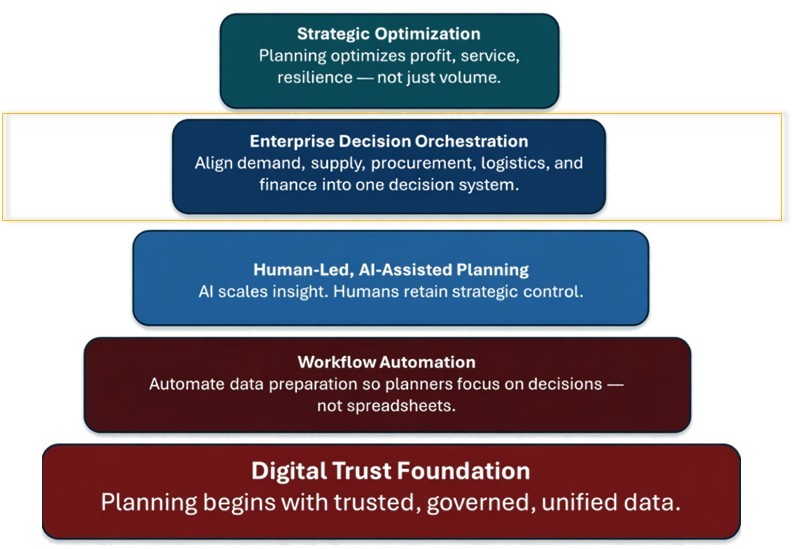
Layer 4 of 5: Enterprise Decision Orchestration
Executive Summary
Most enterprises have invested in their ability to plan. Fewer have invested in their ability to make decisions. While planning creates alternatives for making decisions, orchestration generates results from those decisions. If an enterprise measures its maturity through IBP by how well it makes decisions, then they will reach a plateau as far as achieving functional excellence. However, as long as the organization continues to measure itself using this metric, the potential of creating enterprise value will continue to be stagnant.
The ORCHEST™ methodology has created a framework for developing an architecture that converts the maturity of an organization's planning into the capacity of its leaders. The seven connected components provide the structure needed to create the link between planning maturity and leadership capability. The Decision Cockpit is not simply a tool for viewing data (a dashboard). It is the "operating room" where decisions are made on behalf of an entire organization; all constraints related to each choice are fully visible, and the financial implications of each decision are also visible prior to the time when the decision is actually being made, rather than after.
Planning sophistication vs. decision quality. Most enterprises have built one without the other. The result: high-quality plans that do not translate into high-quality choices at the leadership level — because the governance layer was never designed to receive them.
Most enterprise operating models lack a critical element at their core — and it isn't a planning gap. It's a decision gap. Leaders are making significant investment-related decisions regarding resource allocation and supply chain continuity based upon incomplete information; i.e., the information arrives late, arrives in pieces, or arrives without relevant constraint-based context. The results are poor decisions based upon poorly understood risk.
As many organizations have spent considerable time and money building Integrated Business Planning (IBP), cycles are being done with greater structure, systems have become significantly more sophisticated, and more data is available. However, the basic questions still remain unanswered prior to the Governance Meeting — specifically: What decision does the organization need to make now? What are the current constraints and what are my financial realities? Planning creates better options. Decision Orchestration creates better decisions. The differences lie in Architecture.
The Problem Today
The vast majority of large organizations use their IBP Process as an Alignment Ceremony as opposed to a Decision Engine. Functional leaders attend the meetings having previously established their position(s); finance reconciles their position(s) against previous plans established approximately 90 days ago. The S&OP Meeting has morphed from a decision-making body into simply a vehicle for sharing updates.
Four Structural Inhibitors contribute to this paradigm:
| Structural Failure | Enterprise Reality | Consequence |
|---|---|---|
| Decision Fragmentation | Planning outputs arrive as separate functional artifacts; cross-functional teams reconcile views rather than resolving trade-offs | 60–70% of planning decisions lack explicit ownership; decision cycles measured in weeks |
| Constraint Blindness | Operational limits identified after plans are built, not before; scenarios presented to leadership are commercially credible but operationally impossible | Execution failures, unplanned write-offs, reactive margin erosion |
| Financial Disconnection | Finance validates after execution; operational and financial cycles run separately (PwC, 2025) | Plans that look optimal in isolation erode margin or working capital when executed |
| Governance Without Authority | IBP defines who attends meetings — not who owns trade-offs when constraints collide; decision rights implied, not enforced | Decisions deferred or made outside the process; accountability dissipates between functions |
These failures are related to a common issue. Organizations design processes for planning, but do not create structures for how decisions will be made. The issues with AI are compounded by this lack of structure. Aggressive AI capabilities generate large amounts of possible scenarios, but if those capabilities are not used within the framework of decision architecture, then large numbers of poorly coordinated decisions can be generated quickly.
What Is Changing
In parallel, three structural factors are making simultaneous achievement and necessity for Enterprise Decision Orchestration feasible.
- AI is compressing time for scenario generation and evaluation. McKinsey stated that AI-enabled platforms will be able to produce, evaluate and monetarily measure constraint-based scenarios within hours, rather than days (McKinsey, 2025). Thus, the bottleneck has moved away from whether or not you can obtain the necessary data to support your decision architecture; toward what decision architecture you should use.
- IBP is evolving toward becoming a decision engine. The ASCM IBP Maturity Model describes the highest level of enterprise capability as continuous and integrated decision-making processes wherein all aspects of financial and operations planning are combined — however, only 27 percent of enterprises today operate at this (BCG, 2026) level.
- Constraints are being quantified with a financial basis. Platforms such as Kinaxis and o9 Solutions allow executives to view their margin-at-risk based upon operational limitations (i.e., supplier capacity constraints) on their executive dashboards. Therefore, a supplier capacity constraint is no longer simply an operational footnote — it is also an executive input prior to making a decision.
Core Framework: ORCHEST™
Most enterprises have planning capability but lack decision architecture. ORCHEST™ builds the governance layer that converts planning outputs into leadership choices — with constraints quantified, scenarios pre-built, financial consequences visible before the decision, and decision rights formally assigned.
| Pillar | Design Principle & Enterprise Implication |
|---|---|
OOutcome-Driven Metrics |
Integrated KPIs — service, cost, cash, margin, resilience — govern every decision scenario. Functional metrics inform; enterprise outcomes determine which scenario is chosen. |
RReal-Time Constraint Engine |
Material, capacity, logistics, and financial constraints are embedded into planning logic before scenarios are built. A supplier limit becomes a margin-at-risk figure — a pre-decision leadership input, not a post-planning surprise. |
CCross-Functional Decision Rights |
Explicit RACI and escalation protocols define who owns each trade-off — commercial vs. operations on service, finance vs. supply on inventory. Decision authority is assigned before the next disruption, not during it. |
HHolistic Scenario Simulation |
Rapid, multi-variable what-if analysis incorporating external signals, probabilistic forecasts, and digital twin feedback. AI compresses generation from days to hours; humans govern which option is selected and why. |
EEnterprise IBP Governance |
IBP evolves into a continuous decision governance process. Each cycle begins with the current constraint position and three financially-quantified scenarios. The executive conversation shifts from 'what happened?' to 'which option do we choose?' |
SSynchronized Platforms |
ERP as execution backbone, APS as scenario engine, Decision Cockpit as the synthesis layer — a single source of decision truth. Designed for choice, not observation. |
TTransparency and Auditability |
Full versioning, assumption logging, and decision trails enable organizational learning. Every orchestrated decision links back to strategic intent and forward to execution impact. |
Future State & Operating Model Impact
The Decision Cockpit, within the orchestrated enterprise is a singular governing instrument. This instrument combines an aggregation of constraint status; AI generated option sets based on specific constraints; financial exposure (margin/working capital) as well as risk signals into a single governed interface used by executives to evaluate trade-offs prior to making a Decision — rather than evaluating trade-offs post-Decision execution.
| Dimension | Current State | ORCHEST-Enabled State |
|---|---|---|
| IBP Governance | Monthly review; agenda dominated by reconciliation; financial alignment retrospective | Each cycle begins with live constraint position and three financially-quantified choices |
| Decision Cockpit | Fragmented functional dashboards; decisions made from competing data sets | Single integrated cockpit — constraint position, scenarios, financial exposure — governed before every cycle |
| Financial Integration | Operational and financial cycles run separately; gap reconciliation absorbs leadership time | Every scenario shows margin, working capital, and EBITDA impact before a decision is made |
| Organizational Roles | Planners generate reports; decision authority implied across functions | Planners evolve to Decision Orchestrators; decision rights explicit; finance co-owns scenarios |
3–5 Year Outlook (2028–2030)
| Emerging Capability | Strategic Implication |
|---|---|
| Continuous real-time P&L impact from every planning scenario | IBP becomes a continuous process; monthly financial cycle lags eliminated |
| AI agents auto-generating financially-quantified scenario options | Leadership arrives at governance with pre-built choices; scenario analysis removed from the agenda |
| Cross-enterprise cockpits integrating supplier and market signals | Supply risk becomes a leadership instrument; constraint visibility extends beyond enterprise boundary |
| Agentic execution within governed boundaries — autonomous replenishment and routing | Planners govern outcomes and exceptions; high-frequency decisions execute without human initiation |
Organizations that continue to separate planning from the Decision-making process of their leaders will experience a compounding disadvantage. Competitors employing constraint aware, financially integrated governance will be able to quickly make trade off decisions to protect both margin and service — while organizations with no Decision architecture will continue to reconcile disparate sources of data to determine the various options available.
Governance and IBP Alignment
ORCHEST™ does not replace IBP, it simply redesigns the original intent/purpose of IBP. Governance cadence is structured around three distinct Decision events:
- Routine cadence decisions governed by pre-defined Decision rights
- Constraint triggered escalations surfaced via the ORCHEST cockpit in real-time
- Strategic forums where financially quantifiable scenarios are presented to executive leadership for choice
ASCM's SCOR digital standards provide the structural references. ORCHEST™ enables these standards to become executable decision flows, not governance documentation.
Financial Alignment
Financial integration within ORCHEST is continuous vs cyclical. Each scenario has margin, working capital and EBITDA impact. BCG's 2026 research indicates high-maturity organizations achieve forecasting accuracy advantages exceeding 25 percentage points — but only capture value from that accuracy when consequences are visible at the point of Decision. Working capital is actively managed through constraint aware choices. Margin protection becomes proactive vs reactive. Finance moves upstream as co-architects of the options leaders are choosing between — not downstream validators.
Strategic Actions
| # | Action | What It Means & Why It Matters |
|---|---|---|
| 01 | Conduct an Enterprise Decision Audit | Map every material planning decision — who makes it, what data it requires, what financial consequence follows. Identify authority gaps, information delays, and constraint blindness. This is the ORCHEST baseline. |
| 02 | Redesign IBP as a Decision Engine | Restructure the IBP cycle around governed constraint intelligence and scenario options — not reconciliation. Each review begins with the constraint position and three financially-quantified scenarios. Governance becomes a choice, not a discovery. |
| 03 | Build the Constraint Intelligence Layer | Embed live constraints — supplier capacity, working capital headroom, logistics — into planning architecture in financial terms. Constraints must be expressed as margin-at-risk before scenarios reach leadership. |
| 04 | Implement the Decision Cockpit | Deploy a unified executive interface aggregating constraint status, scenario outcomes, and financial exposure. Designed for decision-making, not monitoring. ERP and APS outputs synthesized, not simply displayed. |
| 05 | Define Cross-Functional Decision Rights | Assign explicit ownership across Finance, Commercial, Operations, and Supply Chain. Define escalation paths and override mechanisms before the next disruption. ASCM SCOR DS provides the structural reference. |
| 06 | Integrate Agentic Scenario Intelligence | Deploy AI to compress scenario generation from days to hours — not to automate decisions. Leaders arrive at every governance cycle with pre-built options and AI-generated trade-off analysis. Human judgment governs the choice. |
Closing Insight
The measure of a supply chain is not how well it plans.
It is how well the enterprise decides.
Every organization has planning ability (talent), planning mechanisms (systems), and planning practices (processes). However, what makes an organization truly unique is not how advanced its planning methods or strategies may be but rather if they deliver the right level of detail and clarity to leaders such that informed choices can be made: with awareness of constraints, financial metrics clearly defined, multiple scenarios considered, and all within the scope of clearly-defined decision-making authority. Planning provides insight. Decision orchestration produces results.
Those organizations that have the capacity to create this new capability will not just react to disruptions — they will define the outcome of their disruptions. The time to develop this capability is now, before the speed at which AI-based decisions are generated exceeds the organizational decision-making process.
With Enterprise Decision Orchestration established as the enterprise decision layer, Series #007 will address the apex of the Trinity Pyramid: Strategic Optimization — where planning optimizes profit, resilience, and service simultaneously. The question shifts from 'which decision should we make?' to 'which portfolio of decisions maximizes enterprise value across horizons?'
Work With Trinity Solutions
Trinity Solutions LLC helps organizations design and implement Enterprise Decision Orchestration — from ORCHEST™ architecture design to Decision Cockpit implementation, cross-functional decision rights definition, and IBP governance redesign — built on the Trinity Pyramid™.
trinitysolutionsglobal.com | Human-Led. AI-Assisted. Wisdom-Driven.
Disclaimer
This white paper reflects the independent perspective of Trinity Solutions LLC.
SCOR® is a registered trademark of ASCM. Trinity Solutions LLC is not affiliated with or endorsed by ASCM.
References
- Gartner — Supply Chain Executive Survey, 2026. Decision cycle improvements from planning automation: 30–50% reduction. gartner.com/en/supply-chain
- Boston Consulting Group — Supply Chain Planning 2026: Why AI Alone Isn't Enough. Garro, Caffrey, Shetty, Dunn, Sieke, Cheraghi. February 2026. bcg.com
- McKinsey Global Institute — The State of AI in Supply Chain, 2025. AI-enabled scenario compression and planning capacity analysis. mckinsey.com
- ASCM — SCOR Digital Standard (SCOR DS) and IBP Governance Framework, 2025. ascm.org
- ASCM — Top 10 Supply Chain Trends 2026. ascm.org/making-an-impact/research/top-10-supply-chain-trends-in-2026/
- PwC — CFO and COO Decision Integration Survey, 2025. pwc.com
- Deloitte — IBP and Integrated Decision Management, 2025. deloitte.com
- MIT Sloan Management Review — Agentic AI in Enterprise Planning, 2025. sloanreview.mit.edu